
For institutions
Curriculum Analysis
Curricular assessments of colleges and universities.
Universities face many tasks, from establishing general education requirements to setting hiring priorities to offering course development grants. Such decisions should be informed by a clear sense of what is being taught. A curricular analysis can provide straightforward answers to important questions. Are people of color underrepresented in the curriculum? Are conservative thinkers rarely assigned? Are contentious issues taught in one-sided ways? Are important topics or thinkers being neglected? A curricular assessment can help set standards in the curriculum as well as identify opportunities for change.
Assessments do not focus on individual faculty or their teaching. Instead, we provide institutions or other stakeholders (such as donors, parents, or potential students) with a fuller sense of the geography of their curricula as a whole.
New report
An Analysis of the Undergraduate Curriculum at the University of Texas at Austin, 2011–2025
Our first major report examines the undergraduate curriculum at the University of Texas at Austin from 2011 to 2025, tracing what students are — and are not — assigned to read across American civics and the great books tradition.
Our Methodology
The Curricular Review Council analyzes universities’ curricula to produce a report on bias and institutional values.
Step 01
Request a Report
A college, university, or other stakeholder contacts the Council.
Step 02
Send CRC materials
Unless publicly available, course syllabi and other documents are sent to the Council.
Step 03
CRC assesses the documents with in-house data tool
The curriculum is reviewed, with an eye to its breadth and balance.
Step 04
Receive report
The report is returned and kept confidential, if requested.
Our Data Tool
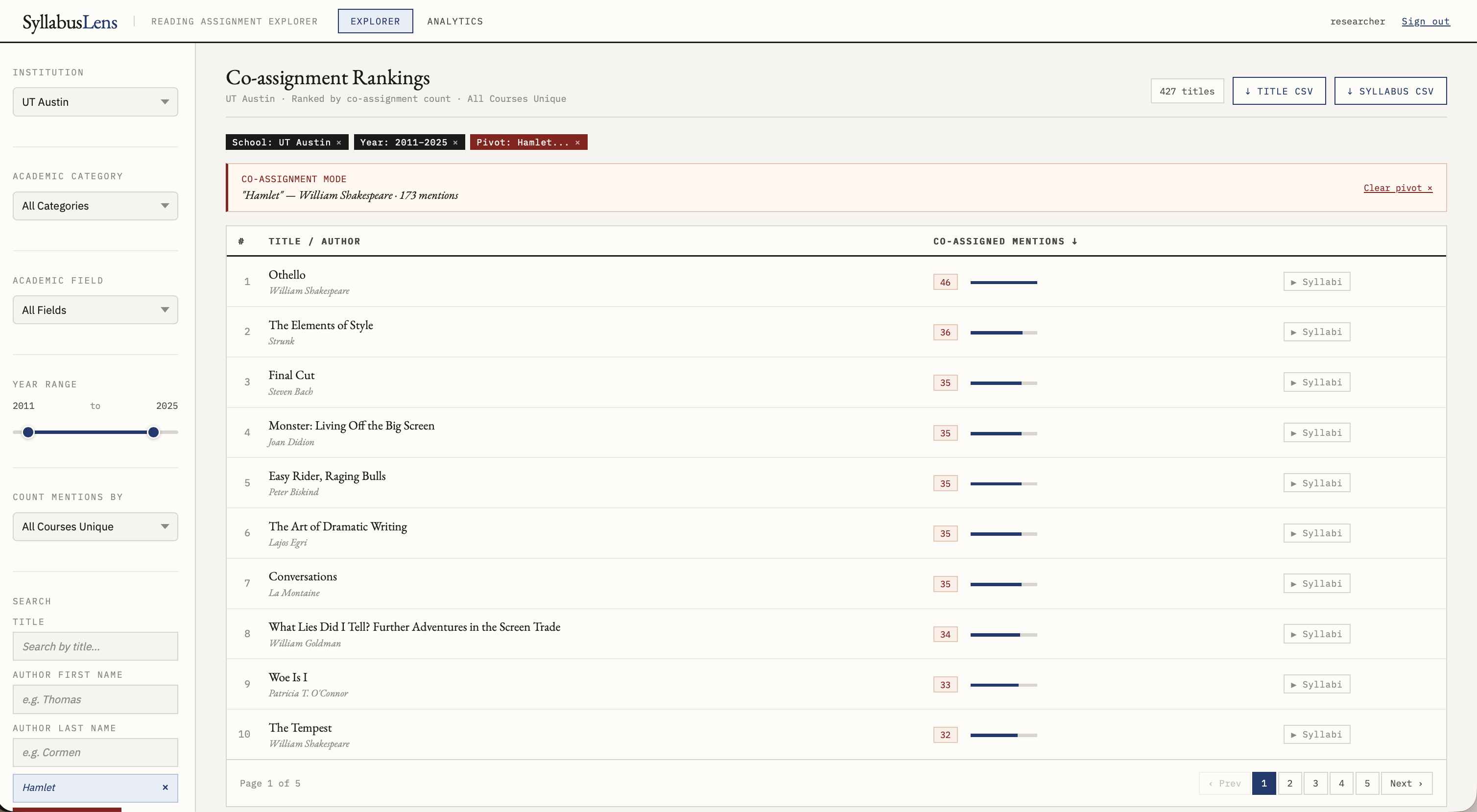
Our curricular analysis utilizes a data tool called Syllabus Lens, designed by Adam Lehavi. Syllabus Lens extracts text titles and author names from syllabi, allowing us to see how often a given work is assigned and in which courses.
Syllabus Lens uses AI, benchmarked against human annotation. It lets us work at a scale beyond the reach of a team of social scientists working alone. In testing, the tool achieved 96% accuracy in extracting author names and 96% recall on titles.
Scale and validation
Syllabus Lens has been run across syllabi published by UT Austin, the University of Florida, and Ohio State University. Its output is benchmarked against a test set of syllabi annotated by hand.
- 146,000
- Syllabi in the corpus
- 3
- Public university syllabus repositories
- 96%
- Recall on assigned titles
- 100
- Hand-annotated syllabi used for validation